
Behaviours and Communication
When we focus on or use terminology such as challenging and difficult behaviour we put the onus on the individual. If we were to rephrase these words and use the word frustrated behaviour or behaviours that challenge, we are taking back the responsibility to understand them so the onus is on us.
As carers to individuals, we should be making the effort to understand their needs and wants. Adapt your way of listening by using your eyes, observe what is occurring for an individual that is using behaviours that require your attention and support.
Behaviours deemed as challenging are often a means of communication and if us as carers do not make the effort to understand then sadly behaviours are ignored or punished in some way and there is a risk of behaviours escalating out of frustration of not being heard or understood.
It is ok for you to feel that your day, your shift, or any time spent supporting an individual as being difficult or challenging, however it is important not to label the individual as such.
By changing terminology, it will help us think more about what is going on for an individual displaying certain behaviours rather than automatically thinking of it as ‘they are being challenging ‘and labelling an individual can have detrimental effect as others may form a prejudgement about them.
Sadly, this happens a lot in our society regardless of whether it is an individual with additional needs or people that have had trauma in their lives.
We are living in a world where you may feel that you need to watch everything you say and we understand that can be frustrating for us all. We are just asking for people to think about how someone who cannot express themselves because of a certain diagnosis or trauma to consider that their actions are not intentional and that they are trying to tell us something in the only way they know how in that moment.
Changing our terminology would be really helpful. Using sentences such as ‘he is very challenging’ sounds so much different to ‘he presents behaviours that can challenge’ rephrasing our wording here indicates that the individual’s behaviour may be challenging for us and does indicate that the individual is challenging.
If you are presented with behaviours that challenge, identifying triggers can often help although these may not always be obvious but still consider that it is about communication. There could be a medical reason, pain, or discomfort. It could be a person’s environment that for some reason upsets them whether it is noise, smells, or colours. It could be the tone of someone’s voice or the fact that there are too many people around them.
Some may feel that an individual is just ‘attention seeking’. Connor certainly did things to grab someone’s attention and these things could be described as disruptive but he did not have a voice as such. He could not say what it was he wanted and if he was ignored or misunderstood then his only way of getting attention was to do something like knock things over to get that attention, quite cleaver! There was always a reason for his behaviour.
‘
Attention seeking’ as it is often put is very often a desire for a need that is not being met. Us as carers should perhaps be more observant and really look at what is going on for that individual at that moment and what can be done to de-escalate the behaviour whilst acknowledging their feelings. Consider what de-escalation techniques might be helpful for an induvial, one size does not fit all.
Establishing clear and consistent routines can help many people, especially people with autism. If routines have to be changed then try to have a back up plan on how to deal with changes if you can. This is where visual aids can be so important and useful as it can help individuals regulate their thoughts and feelings about what is happening in their day and why.
Ultimately dealing with behaviours that may challenge us requires us as carers to remain calm, use person-centred strategies to come up with solutions that will help an individual in that moment of distress. Remember a challenging behaviour is often a form of communication indicating a sensory overload, pain, boredom, or fear. Identifying triggers may be helpful so you can avoid certain situations but sometimes behaviours can just be random and we have to think outside of the box. If the individual has another way of communicating such as an app on an iPad, make sure they always have access to this.
It is very helpful that all carers involved in a person’s care are on the same page to avoid confusion. This gives clear consistency for an individual especially if they prefer routine. If you think how important it is to you to be heard and understood, just try to remember it is no different for someone with a learning difficulty, we just have to listen in a different way. It is our responsibility, not theirs.
Always seek help if you are unsure how to manage a situation. Never feel you should be able to cope if you are not. By trying to deal with a situation by yourself could be detrimental for the individual you are supporting. Dealing with a behaviour that challenges you is difficult and there is no shame whatsoever in reaching out, talking about it and getting extra support if needed.
I got help when Connor was a little younger because I was struggling with some of the behaviours he was presenting. Once I got the help I needed it helped me to be more empathetic to his needs and understand that his actions were not him being naughty or destructive they were his way of telling me that something was not right for him. It helped me to observe what was going on for him and make the appropriate changes to help him feel more comfortable and more importantly understood.
Communication aids are also important for many people with a learning difficulty or speech impairment. Using a communication system that supports an individuals ability to use their voice can alleviate many frustrations which lead to behaviours that challenge. Symbols, pecs (Picture exchange communication system), social stories, makaton training, switch devices and augmentative and alternative (AAC) are just some of the available recourses. More is explained by Nicola, mum to Fergus about the importance of communication visuals next on this page.




Introducing Nicola and her Son, Fergus.
My name is Nicola, I am the proud mum of two amazing young adults, Katy who is 21 and Fergus who is 18!
Fergus was born 5 weeks early and diagnosed with chronic renal function at birth, he was diagnosed with down syndrome on day 3 and at the age of 6 was diagnosed with Autism.
Along with being an awesome mum to these two rockstars, I worked full-time in education. First as a mainstream teacher then I moved into the special needs sector, and thoroughly enjoyed being an assistant head for the last 7 years. I have learnt a lot and I have shamelessly used all these skills in supporting my son Fergus as he has grown over the years.
For me, communication is key! I used to say that I wanted every child I taught be as independent as they could be and to communicate in a way that suited them to the best of their ability. Let me be very clear that I do not mean verbal communication, I mean communication whatever that may look like for individual children.
Fergus is classed as pre-verbal, he has some words. I taught children that were both verbal and non verbal throughout my time in education. One of the biggest barriers I used to face was explaining that even though a child cannot speak, they absolutely can understand. I also had to battle the expectations that even if a child or young adult was verbal, they still needed visuals to support them in understanding the world around them.
It was also during this period of my professional life that I learnt more about the use of and the importance of visuals to support a young persons development and understanding.
What I want to be able to do alongside
Kate, is create an opportunity to share
my knowledge of visuals and
how this can help our young people
regardless of cognitive level, to be able
to interact with their families,
community experiences and life.

Visual aids.
Fergus has been exposed to a very visual rich home environment since he was 6 years old. I finally saw him show me he was really understanding and using them in his own way when he was 15! Processing time is key!
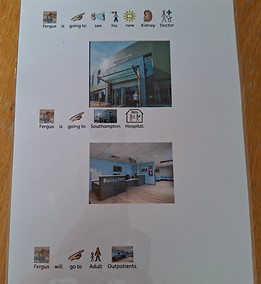
So this is a journey! And every journey is different. Fergus has a visual term calendar up in the kitchen, and he has social stories for many different aspects of his life such as being safe with his iPad, visiting the hospital and going on exciting trips out with friends.
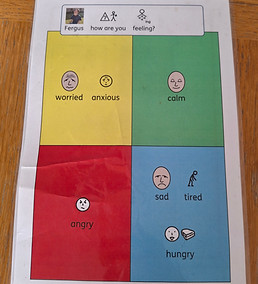
He also has visuals to support his emotional regulation! This was so powerful when he went through puberty.
There is so much I am excited to share with you all, but also I am excited to help other families to discover the magic of visuals and see for themselves the difference they can make! I truly believe in Kate’s vision to bring a community together where we can learn from each other and advocate for our young people.